 |
 |
Editor: Dr Tim Harding |
 |
 |
 |
 |
 |
 |
|
|
Editor: Dr Tim Harding |
|
|
|
|
|
|
© Dr Tim Harding
Last modified:
24 October 2026
Round 11 at Hastings was played on the 17th of August 1895.
There are two problem games in this round. Curiously, both have the same issue about what was the move order to reach the Four Knights Game, specifically what Black played at move two. There are also disagreements about how both games ended.
According to ChessBase Mega Database 2025 the score of this game was: 1.e4 e5 2.Nf3 Nf6 3.Nc3 Nc6 4.Bb5 Bb4 5.Nd5 Nxd5 6.exd5 e4 7.dxc6 dxc6 8.Be2 exf3 9.Bxf3 0–0 10.0–0 Bd6 11.d4 f5 12.c4 Be7 13.d5 c5 14.Bd2 Bd6 15.Rc1 Qf6 16.Bc3 Qh6 17.g3 f4 18.Bg4 fxg3 19.hxg3 Bxg3 20.fxg3 Rxf1+ 21.Qxf1 Bxg4 22.Qf4 Qxf4 23.gxf4 Rd8 24.Be5 Rd7 25.Kf2 Kf7 26.Rg1 h5 27.Kg3 Kg6 28.b3 Kf5 29.Re1 Re7 30.Bc3 Rxe1 31.Bxe1 g6 32.Bc3 Bd1 33.Be5 g5 34.Bxc7 gxf4+ 35.Kf2 Bc2 36.Bb8 a6 37.Kf3 Be4+ 38.Kf2 Bb1 39.Bd6 Bxa2 40.Bxf4 Bxb3 41.d6 Ke6 42.Ke3 Bxc4 43.Kd2 Bb5 44.Kc3 Bc6 45.Kc4 b6 46.Bg3 Bd5+ 47.Kc3 b5 48.Kd3 a5 49.Ke3 a4 50.Kd3 a3 51.Kc2 b4 52.Be5 b3+ 53.Kc3 b2 0–1
The official tournament book, edited by Horace Cheshire (pages 173-174) had notes by Albin. It clearly says that Black’s second move was “Q Kt to B3” (i.e., 2…Nc6) and not 2…Nf6 as in the version above. BCM (October 1895 pages 431-432) also says that 2…Nc6 was played.
The 2…Nf6 move order is implausible because Steinitz is only known to have taken the Black side of the Petroff Defence in two games against amateurs. ChessBase follows Schallopp’s German tournament book (pages 191-193), but his source is unknown. Bachmann’s Schachmeister Steinitz (volume 4, page 75, game 792), The Weltgeschichte des Schachs collection of Steinitz’s games, and my own Steinitz in London (game 585 on page 327) all follow Cheshire with 2…Nc6 (though an error in my book wrongly says Bachmann had 2…Nf6).
There is also a disagreement about when the game ended. BCM, Schallopp, Bachmann etc. say White resigned after Black’s 51st move, but Cheshire has the two extra move pairs shown above indicating that the game actually concluded after Black’s 53rd move. There is a slight possibility that the extra move pairs were intended to be a clarifying note by the editor that accidentally got added to the score, but it is impossible to be certain. It is somewhat curious that ChessBase follows Schallopp over move two but copies Cheshire about the finish.
Conclusion: I think we can be definite that the second move was 2…Nc6 but less certain whether the move pairs 52-53 are genuine. Failing conclusive evidence emerging to the contrary, the opening sequence should be amended to 1. e4 e5 2. Nf3 Nc6 3. Nc3 Nf6 in any database that has the Petroff move order.
According to ChessBase Mega Database 2025 the score of this game was: 1.e4 e5 2.Nf3 Nf6 3.Nc3 Nc6 4.Bb5 a6 5.Bxc6 dxc6 6.Nxe5 Nxe4 7.Nxe4 Qd4 8.0–0 Qxe5 9.Re1 Be6 10.d4 Qf5 11.Bg5 h6 12.Qd3 Kd7 13.Bh4 Re8 14.Re3 Bd6 15.Rae1 Qb5 16.Nxd6 cxd6 17.Qa3 a5 18.c3 Qb6 19.Bg3 Qc7 20.c4 Bxc4 21.Rxe8 Rxe8 22.Rxe8 Kxe8 23.Bxd6 Qd7 24.Qe3+ Be6 25.Bc5 f6 26.a3 Kf7 27.Qg3 Bd5 28.h3 Qe6 29.f3 Qe3+ 30.Qf2 Qb3 31.Kh2 b6 32.Bd6 Be6 33.Qd2 h5 34.Bc7 a4 35.Bg3 b5 36.Be1 Bf5 37.Qf2 Qc2 38.Qxc2 Bxc2 39.Kg1 Ke6 40.Kf2 Kd5 41.Ke3 Kc4 42.g3 Bd3 43.Bc3 Bf1 44.h4 Bh3 ½–½.
The case with the opening sequence is the same as in the previous game. Schallopp had 2…Nf6 and made brief comments about the Petroff Defence but most sources say Tarrasch played 2...Nc6. It is as yet unknown what was Schallopp's source for the Petroff move order. Tarrasch very rarely played 2...Nf6 although there is some reason to suppose that he did play it against Albin in the next round, as we shall explain in the next article.
There is also only one known game in which Schlechter definitely met 2…Nf6 by transposing to the Four Knights, which was in his first meeting with Horatio Caro (Berlin 1897). On most occasions in his mature years, he played 3 Nxe5, as in a later game with Caro, and he had already won a game in 1895 against Jacques Schwarz with 3 Nxe5 in a Vienna tournament. So it is probable that Cheshire is right and that the Four Knights was reached via 2…Nc6.
The Schallopp tournament book, like ChessBase, ends after move 44 in the diagram position, saying drawn: "Als unentschieden abgebrochen." Consequently databases including ChessBase Mega Database 2025 usually end here.
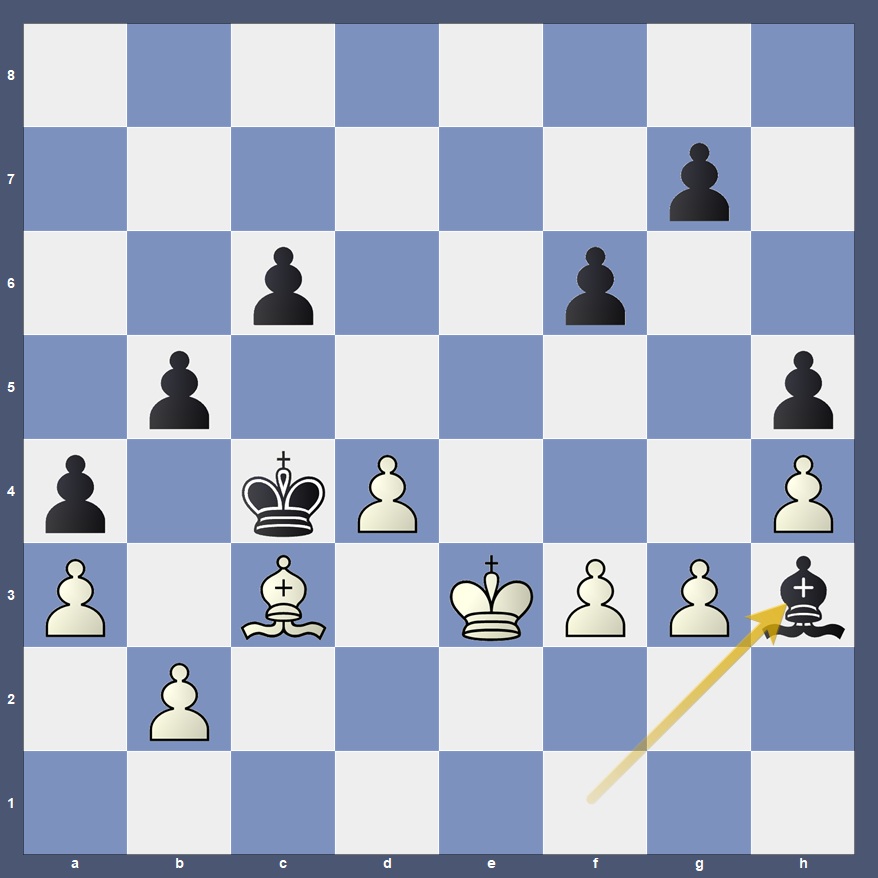
On the length issue, the official tournament book (ed. Cheshire), with notes by Von Bardeleben, goes to move 52 as follows: 45. Kd2 Kb3 46. f4 Bg4 47. Kc1 Ka2 48. Bb4 g6 49. Kc2 Bf5+ 50. Kc3 Be4 51. f5 gxf5 52. Be7 ½–½. It now says: "Drawn game" and Britbase stops here also.
Cheshire probably had no further moves available to him, and maybe Bardeleben did not receive a full score. Both the Deutsche Schachzeitung (December 1895, pages 368-369) and Schlechter’s column in the Vienna Allgemeine Sportzeitung (6th October) but said the game continued to move 60. It seems that the additional moves were not preserved anywhere, similar to the case with the Steinitz-Blackburne game from an earlier round.
Both the Schachzeitung and Schlechter stopped after Black’s 23rd move and their comments are somewhat amusing. The German magazine said: "The game was dragged on with an interesting endgame all the way up to the 60th move before it was called a draw. Both players could have spared themselves this futile effort, just as we want to leave it to our readers to guess the remaining moves." We detect a note of sarcasm in the choice of the adjective "interesting."
In the Sportzeitung, Schlechter commented: "The game, which no longer offers any interest from this point on, will continue up to the 60th move and then eventually be called a draw." It seems that Tarrasch was determined to test his young adversary, whom he had beaten in their only previous game (Leipzig 1894). Hoffer said as much in his summary of the round in The Field (31 August, page 386), mentioning "an unnecessarily protracted attempt to win on the part of Tarrasch."
Conclusion: In this game, too, we think Black played 2...Nc6 not 2...Nf6. We see no good reason why Schallopp and ChessBase stopped at move 44.
This series will continue soon with Round 12 and onwards...
 Back to the index (introduction) page for the series.