 |
 |
Editor: Dr Tim Harding |
 |
 |
 |
 |
 |
 |
|
|
Editor: Dr Tim Harding |
|
|
|
|
|
|
© Dr Tim Harding
Last modified:
26 October 2026
Round 12 at Hastings was played on the 17th of August 1895.
There are three games with discrepancies in this round, but only the third one requires a diagram.
ChessBase Mega Database 2025 gives the score of this game as 1.e4 e5 2.Nf3 Nc6 3.Nc3 Nf6 4.Bb5 Bb4 5.Nd5 Nxd5 6.exd5 e4 7.dxc6 dxc6 8.Be2 exf3 9.Bxf3 0–0 10.0–0 f5 11.c3 Bd6 12.Qb3+ Kh8 13.d4 Qh4 14.g3 Qf6 15.h3 h5 16.Kg2 h4 17.Rg1 hxg3 18.fxg3 f4 19.Bxf4 g5 20.Bxd6 Qxf3+ 21.Kh2 cxd6 22.Rgf1 Qe2+ 23.Kg1 Bxh3 0–1
The issue in this miniature game parallels what we said in the previous (Round 11) article about the game Schlechter-Tarrasch, whether the Four Knights Game was reached via the Petroff move order (2…Nf6) or via 2…Nc6 as ChessBase, following Schallopp (pages 197-198, says. In that game we argues that Tarrasch almost certainly played his usual 2…Nc6.
This time it is Cheshire (page 187) who has “Kt to KB3” (i.e., 2…Nf6) with notes by Blackburne. Schallopp says the notes in his book were “from Tarrasch supplemented by a few more” but seems not to have noticed that when Tarrasch annotate the game for the Deutsches Wochenschach (13th October 1895, pages 360-361) he gave the 2…Nf6 move order.
Schlechter also published this game in his Allgemeine Sportzeitung column on 27th October with the 2...Nf6 move order.
We think there is a simple explanation why Tarrasch, with little time to prepare (since he only learned his opponent and colours for the day at breakfast) decided to switch from his usual second move. He could not be sure whether Albin would meet 2…Nc6 by 3 Bc4 (which he had already played twice in the tournament) or 3 Bb5 (which he employed in round 11).
More to the point, perhaps, Tarrasch would have seen that in round 6 Albin had met Schlechter’s 2…Nf6 by the dubious 3 Bc4 and would have liked a chance to refute that gambit if it was repeated. Also Tarrasch probably knew that Albin in his 1894 match with Delmar had met 2...Nf6 with 3 Nc3, leading to a Four Knights.
Conclusion: Since the notes in the Wochenschach were by Tarrasch, and he had good reason to hope for a weak reply from Albin, it is safe to assume that he really did play 2…Nf6.
ChessBase Mega Database 2025 gives the score of this game as 1.e4 e5 2.f4 d5 3.Nf3 dxe4 4.Nxe5 Bd6 5.d4 exd3 6.Bxd3 Nf6 7.0–0 0–0 8.Nc3 Nbd7 9.Nxd7 Qxd7 10.Qf3 Rb8 11.f5 b6 12.Bg5 Bb7 13.Qh3 Nd5 14.Ne4 f6 15.Bd2 Rbe8 16.Rad1 Re5 17.Kh1 Rfe8 18.Nxd6 Qxd6 19.Qg3 Qc5 20.Bh6 R8e7 21.c4 Ne3 22.Be4 Nxd1 23.Rxd1 Qd6 24.Rxd6 cxd6 25.Be3 Rxe4 26.Bf2 Rxc4 27.h3 Rc6 28.Kh2 Re5 29.Qd3 h6 30.b4 a6 31.Qb3+ Kf8 32.Bg3 Re7 33.a4 b5 34.a5 Ke8 35.h4 Rc4 36.Qd1 d5 37.Bf2 Kf7 38.g4 Kg8 39.g5 hxg5 40.hxg5 fxg5 41.Qh5 Rf4 42.Kg3 d4 43.Qxg5 Rf3+ 44.Kg4 Rd7 45.Qg6 Kf8 46.Bh4 d3 47.Qe6 Rf7 48.Qd6+ Kg8 49.Be7 d2 50.Qb8+ Kh7 51.Qh2+ ½–½.
There is a length issue. Cheshire (pages 187-188, with notes by Von Bardeleben) ends after 50 Qb8+. The Deutsches Wochenschach (29th September, pages 345-346) finished 49 Be7 d2 50 Qb8+ “and White takes a draw by perpetual check.” The Schachzeitung (November, pages 339-341) says the same. ChessBase follows Schallopp (pages 207-209) with the extra move pair but perhaps he just added those moves for explanatory purposes.
Conclusion: There is no evidence that further moves were played after 50 Qb8+.
ChessBase Mega Database 2025 gives the score of this boring draw as 1.d4 d5 2.c4 dxc4 3.e3 e5 4.Nc3 exd4 5.exd4 Nf6 6.Bxc4 Be7 7.Nf3 0–0 8.0–0 b6 9.Ne5 Bb7 10.Qb3 Qe8 11.Re1 Nc6 12.Nxc6 Qxc6 13.d5 Qc5 14.h3 a6 15.a4 Qb4 16.Bf4 Qxb3 17.Bxb3 Bb4 18.Bxc7 Bxc3 19.bxc3 Bxd5 20.c4 Rfc8 21.Bxb6 Bxc4 22.Bd1 Rab8 23.Bd4 Bb3 24.Be2 Rb4 25.Bxa6 Ra8 26.Bxf6 gxf6 27.Bb5 Bxa4 28.Bd3 Rd8 29.Re3 Rbd4 30.Be2 Bd1 31.Bf1 Bc2 ½–½
The question is what did Steinitz play at move 14 (see Diagram)?
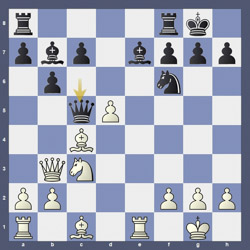
I now think I was wrong (in Steinitz in London) to accept 14 h3 (P-KR3 in descriptive notation) and I should have preferred the official Cheshire tournament book which has 14 P-QR3 (a2-a3) and notes by Pillsbury (see pages 195-196). When researching that book, I had not yet seen the Deutsches Wochenschach (13th October, page 361) which also has 14 a2-a3. The continuation of the game makes more or less equal sense with either move.
Schallopp (page 204), noted that the English sources gave a2-a3 and that Pillsbury had criticised the waste of time by moving the a-pawn twice, saying White should have preferred 14 Bf4. Schallopp said that 14 h3 made sense as a prophylactic move, but after 14 a3 Black was not threatening either …Ng4 (which would be met by Ne4) nor ...Bd6 (which would hem in the queen and fail to 15 Be3 Qa5 16 Qc2).
Bachmann and Hooper’s books on Steinitz give 14 a3 a6 15 a4. Steinitz probably played 14 a3 to prevent …Qb4 but after 14…a6 he decided to move the pawn again to stop …b6-b5.
Conclusion: Many databases have 14 h3 but it should be changed to 14 a3, following Cheshire.
This series continues with Round 13 and onwards...
 Back to the index (introduction) page for the series.