 |
 |
Editor: Dr Tim Harding |
 |
 |
 |
 |
 |
 |
|
|
Editor: Dr Tim Harding |
|
|
|
|
|
|
© Dr Tim Harding
Last modified:
27 October 2026
Round 17 at Hastings was played on the 27th of August 1895.
This round saw an important change at the top of the standings, because Chigorin and Lasker were both held to a draw. Pillsbury made his first move but Von Bardeleben was late, and sent a note to say he was unwell and so forfeited the game. Pillsbury thus joined the leaders on 13½ points.
Steinitz lost and remained on 10 points, being joined on that score by Walbrodt (who eventually drew after an adjournment) and Dr Tarrasch, who won his game. Next in the standings was Schlechter, who won his game and moved to a plus score for the first time in the tournament.
There were three problem games in this round.
The score of this game in ChessBase’s Mega Database 2025 is as follows: 1. e4 e5 2. Nf3 Nc6 3. Bc4 Bc5 4. d3 Nf6 5. Nc3 d6 6. Be3 Bxe3 7. fxe3 Na5 8. Bb3 O-O 9. O-O Nxb3 10. axb3 c6 11. Qe1 Ne8 12. Qg3 f6 13. Nh4 Be6 14. Rf2 Qb6 15. Raf1 Rd8 16. Kh1 Rd7 17. Nf5 Kh8 18. Na4 Qc7 19. Qh4 b6 20. Nc3 Qd8 21. Qg3 Nc7 22. Nh4 Re8 23. Qf3 Bf7 24. Nf5 Be6 25. Qg3 Bxf5 26. Rxf5 Ne6 27. Qf2 Ng5 28. Qe1 d5 29. Qh4 d4 30. exd4 Rxd4 31. Ne2 Rd7 32. Qf2 Ne6 33. Qe3 Qe7 34. R5f2 Qb4 35. Ng3 a5 36. Ra1 Nc5 37. Qc1 Red8 38. Nf5 Qb5 39. g4 Ne6 40. Qe3 Nf4 41. Rd2 c5 42. Qf2 c4 43. dxc4 Rxd2 44. Qxd2 Rxd2 45. cxb5 Rxc2 46. Rb1 Nh3 47. Ne3 Rc5 48. Kg2 Nf4+ 49. Kf3 h5 50. b4 Rxb5 51. bxa5 hxg4+ 52. Kxg4 bxa5 53. Nc4 Ne6 54. h4 Nd4 55. Ra1 Nc6 56. Kf5 Rb4 57. Nxa5 Nxa5 58. Rxa5 Rxb2 59. Kg6 Rg2+ 60. Kh5 Kh7 61. Ra7 Re2 62. Rb7 Kg8 63. Kg6 Rg2+ 64. Kh5 g6+ 65. Kh6 Rg4 66. Rg7+ Kf8 67. Ra7 f5 68. exf5 gxf5 69. Kh5 Rg7 70. Ra8+ Kf7 71. Ra7+ Kg8 72. Ra5 f4 73. Rxe5 f3 74. Rf5 Rf7 75. Rg5+ Kf8 76. Rg1 Rg7 77. Rf1 Rg3 78. Kh6 Kf7 79. h5 Kf6 80. Kh7 Kf5 81. h6 Kf4 82. Kh8 ½–½
The problem here is to do with move order in the opening, the difference coming at move 8. See the diagram.
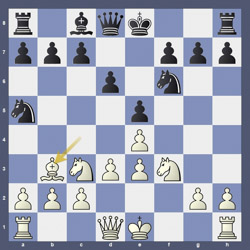
Cheshire (pages 264-266, with notes by Tinsley) had “8…P to B3 9 Castles KtxB 10 RP x Kt Castles”, which in algebraic notation is 8…c6 9 0-0 Nxb3 10 axb3 0-0. On the other hand, Schallopp (pages 259-261) has 8…0-0 9 0-0 Nxb3 10 axb3 0-0, which is an evident misprint with Black castling twice.
Changing the first …0-0 (at move 8) to …c6 (to match Cheshire) would seem to be the obvious correction and that is what is shown in the Weltgeschichte des Schachs collection of Lasker’s games that was edited by Ludwig Rellstab. Instead, ChessBase and both the modern editions by Crouch (pages 243-244) and Pickard, and also Renette’s biography of Lasker, go with 8…0-0 9 0-0 Nxb3 10 axb3 c6 for no obvious reason.
We went in search of other primary sources to see if any would clarify this, but understandably such a long drawn game was not a favourite with editors.
Conclusion: In view of the obvious error by Schallopp, and the absence of any evidence to the contrary, the Cheshire/Rellstab move order should be accepted. ChessBase need to correct their database.
The score of this game in ChessBase’s Mega Database 2025 is as follows: 1.e4 c5 2.Nf3 Nc6 3.Nc3 g6 4.d4 cxd4 5.Nxd4 Bg7 6.Be3 h5 7.Be2 d6 8.Qd2 Bd7 9.0–0 Nf6 10.h3 Qc8 11.f4 Kf8 12.Rad1 h4 13.Nxc6 Bxc6 14.e5 dxe5 15.fxe5 Nh5 16.Bg4 Qc7 17.Qf2 Be8 18.Nd5 Qxe5 19.Nxe7 Bf6 20.Nd5 Bg7 21.Bc5+ Kg8 22.Ne7+ Kh7 23.Rd5 Ng3 24.Rxe5 Bxe5 25.Re1 Bxb2 26.Bd4 Bxd4 27.Qxd4 f5 28.Nxf5 1–0
The divergence in this case occurs at the finish; see the diagram after Black’s 27th move. There is general agreement that White’s 28th move involved his Knight capturing a pawn — but which one?
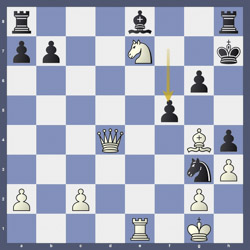
Both moves win and The Times (29 August) unhelpfully ended with the ambiguous "28 Kt x P and White wins." Hoffer, in The Field, (7 September 1895, page 410) unhelpfully gave only a diagram followed by moves 19-25 only, saying “White wins”. This probably means that he had seen the game in The Times and was unable to verify how the game actually ended.
Cheshire (pages 267-268, with notes by Gunsberg) has "28 Kt x Kt P", i.e., 28 Nxg6, and Crouch (page 245) agrees. On the other hand, Schallopp (pages 263-264) has 28 Se7 xf5 (i.e., Nxf5 or Kt x BP in descriptive notation). The capture on f5 was the move given in the Deutsches Wochenschach (8th September, page 319) and also by Schlechter in his column on October 27th. ChessBase and Renette's biography of Bird follow Schallopp.
Conclusion: The evidence from sources is inconclusive but 28 Nxf5 (which threatens mate in one) is more forcing and should probably be accepted.
The score of this game in ChessBase’s Mega Database 2025 is as follows: 1.e4 e5 2.Nf3 Nc6 3.d4 exd4 4.Nxd4 Nf6 5.Nxc6 bxc6 6.e5 Qe7 7.Qe2 Nd5 8.c4 Qb4+ 9.Nd2 Nf4 10.Qe4 Ne6 11.f4 Bb7 12.a3 Qb6 13.Nf3 c5 14.Qd3 Nd4 15.Nxd4 cxd4 16.b4 c5 17.Rb1 Qc6 18.bxc5 Bxc5 19.Bb2 0–0 20.Bxd4 Bxd4 21.Qxd4 f6 22.Bd3 fxe5 23.fxe5 Rae8 24.Rb2 d6 25.Qxa7 Rxe5+ 26.Kd1 Bc8 27.Qb6 Qa4+ 28.Qb3 Qa7 29.Kc1 Ra5 30.Ra2 Bf5 31.Bxf5 Raxf5 32.Rd1 Rb8 33.Qd3 Rc5 34.Rc2 Rbc8 35.Qb3 Rb8 36.Qd3 Rb6 37.Qe3 Re5 38.Qf3 Qb8 39.Rd3 Rb1+ 40.Kd2 Rbe1 41.Rd5 Re8 42.Rb5 Qa7 43.Rb3 Qd4+ 44.Rd3 Qa1 45.Rdc3 R1e5 46.Rc1 Qb2+ 47.R1c2 Qb6 48.Rc1 Qd4+ 49.Kc2 Re2+ 50.Kb1 Rb8+ 51.Ka1 Rbb2 52.Qa8+ Kf7 53.Rf3+ Kg6 54.Rg3+ Kh6 55.Rh3+ Kg6 56.Rg3+ Kh6 57.Rh3+ Kg6 58.Rg3+ ½–½
The diagram shows the position after White’s 45th move, where the discrepancy occurs. After Black’s 49…Re2+ the two versions reach the same position and do not vary again.
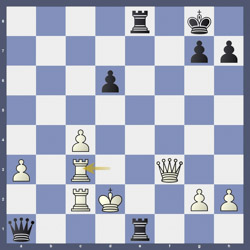
Cheshire (pages 268-270) has “R(K8) to K5” which in algebraic is 45…Re1-e4 whereas Schallopp (pages 266-267) has 45…Re1-e5, which ChessBase follows, as did Pickard. In his notes, Schiffers said 45…Rf1 would have been much stronger and Schallopp agreed. Crouch (pages 241-243) followed Cheshire.
The move given by Cheshire, although not the best, does not spoil Black’s winning position. John Saunders on Britbase observes correctly that 45…R1e5 would allow White to equalise with 46 Qd1 and comments: “I suspect it might be a typical case of a writer attuned to algebraic notation misinterpreting the English descriptive move R(K8)-K5 as it was recorded in the Cheshire book.”
Conclusion: As with Mason-Lasker, this long drawn game was unsuited to chess columns and magazines so we did not find other sources to check. We agree with Saunders that the official tournament book is probably correct and that, once again, ChessBase has misguidedly followed Schallopp’s version of events.
This series will continue soon with Round 18 and onwards...
 Back to the index (introduction) page for the series.