 |
 |
Editor: Dr Tim Harding |
 |
 |
 |
 |
 |
 |
|
|
Editor: Dr Tim Harding |
|
|
|
|
|
|
© Dr Tim Harding
Last modified:
2 November 2026
The penultimate Round 20 at Hastings was played on the 31st of August 1895.
It began with a huge surprise as tournament leader Chigorin lost with White to Janowski in 16 moves. More chaos followed. As Cheshire observed in the official tournament book, the date was notable “in being disastrous to the White forces, which only score 2½ out of 11.”
The world champion Lasker lost to local hero Blackburne. The English veteran had previously lost nine games to Lasker (with a few draws) but never beaten him. (Blackburne would later beat Lasker again at London 1899 and lose two more games to him.)
These results opened the door for Pillsbury to retake the lead because he was paired with the “rabbit” Vergani, who lost his last six games in the tournament.
There is only one problematic game in this round, but it was a very important clash, the first ever meeting between the ex-world champion, William Steinitz, and Dr. Siegbert Tarrasch could hardly have been more important or more dramatic.
The players had been level on 12 points, so it was vital for the destination of fourth prize, which was £60. The tension of the occasion may have affected both their play, with Tarrasch unwisely choosing the Dutch Defence rather than try to defend the Queen’s Gambit.
At the first time control (move 30) Steinitz was clearly winning in a queenless middle game. Even after his unnecessary pawn sacrifice at move 32 (where he should simply have played Rc1 as Tarrasch said) White would still have had his opponent tied up had he found 34 Bf8! (spotted by Stockfish but not by the contemporary annotators). Further errors followed on both sides but eventually Tarrasch adjourned in a winning endgame, that was not completed until the evening after the last round, because there was no play on Sunday 1st September. Steinitz, as Tarrasch wrote, probably ran out of energy after the first session. This was an expensive defeat which cost him £20 (had he beaten Tarrasch) or £10 if they had drawn.
The score of this game according to ChessBase’s Mega Database 2025 was as follows: 1.d4 f5 2.c4 e6 3.Nc3 Bb4 4.e3 Nf6 5.Bd3 b6 6.Nge2 Bb7 7.0–0 0–0 8.f3 Nc6 9.e4 fxe4 10.fxe4 e5 11.Nd5 Be7 12.Nxf6+ Rxf6 13.Rxf6 Bxf6 14.d5 Ne7 15.Ng3 g6 16.c5 Kh8 17.Be3 Ng8 18.Qc1 Qe7 19.cxb6 cxb6 20.Qc7 d6 21.Qxe7 Bxe7 22.a4 Bd8 23.Ne2 a6 24.Nc1 Ne7 25.Nb3 Kg7 26.Rf1 Nc8 27.Nd2 Be7 28.Be2 Bd8 29.Bg4 b5 30.Be6 Bf6 31.a5 g5 32.h4 gxh4 33.Bh6+ Kg6 34.Bg4 Ne7 35.Be3 Rf8 36.Rc1 Bc8 37.Be2 h3 38.g3 h5 39.Rc7 Rg8 40.Kh2 Rf8 41.Bd1 Ng8 42.Rc6 Be7 43.Nf3 Nf6 44.Nh4+ Kf7 45.Bf3 Bg4 46.Bh1 Bd7 47.Rc7 Rc8 48.Rxc8 Ng4+ 49.Kg1 h2+ 50.Kf1 Nxe3+ 51.Ke2 Bxc8 52.Kxe3 b4 53.Nf3 Bd8 54.Nxh2 Bxa5 55.Bf3 Kg6 56.Be2 Bb6+ 57.Kd2 a5 58.Bb5 Bf2 59.Nf1 Bh3 60.Ke2 Bxf1+ 61.Kxf1 Bxg3 62.Be8+ Kg5 63.Kg2 Be1 64.Kf3 h4 65.Bd7 a4 66.Bxa4 h3 67.Bd7 h2 68.Kg2 Bg3 69.Be8 Kf4 70.Bh5 Ke3 71.b3 Bf4 72.Bg6 Kd3 0–1
Apart from the difficulty of understanding what was really going on in this game, there are several discrepancies between the scores in the tournament books. Cheshire (pages 310-312) had notes by Mason and a different move order from the above in the three places shown above by bold type.
The version of the game that has apparently achieved universal currency stems from Tarrasch. His annotations for the Frankfurter Schachblatt were reprinted in both the Deutsches Wochenschach (3rd November, pages 381-383) and the Deutsche Schachzeitung (November 1895, pages 336-338). They were copied thereafter in Schallopp (pages 300-302) and Bachmann’s Schachmeister Steinitz #801.
Not only Bachmann and Hooper but also Pickard, Crouch/Haines (pages 281-282) and ChessBase follow Tarrasch, via Schallopp, so far as the move sequence is concerned. Only the old Leguan database closely followed the Cheshire book.
There is first a disagreement over opening move order (5-7) and also later in the game there were sequences swapped at 57B-59W and 62W-63B.
Cheshire (pages 310-312) has "5…Castles, 6 Kt to K2 P to QKt3 7 Castles B to Kt2" (i.e., 5…0-0 6 Ne2 b6 7 0-0 Bb7) whereas Schallopp (pages 300-302) has 5…b6 6 Nge2 Bb7 7 0-0 0-0 which is the generally accepted version. Can anyone see a reason to prefer one sequence over the other?
Moving to the latter stage of the game, our diagram shows the position after White's 57th move.
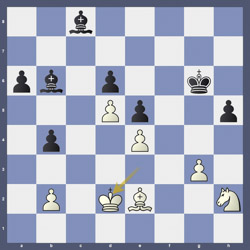
Now Cheshire has “57…B to B7 58 Kt to Bsq P to R4 59 B to Kt5" (i.e., 57…Bf2 58 Nf1 a5 59 Bb5) whereas Schallopp has 57…a5 58 Bb5 Bf2 59 Nf1.
Finally, Cheshire has “62 K to Kt2 B to K8 63 B to K8ch K to Kt4.” (i.e., 62 Kg2 Be1 63 Be8+ Kg5) but Schallopp has 62 Be8+ Kg5 63 Kg2 Be1!
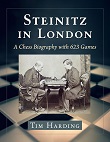
Conclusion: It is hard to know what to think about this game. So far as the assessment of the position is concerned, the differences at the end do not matter; Black was clearly winning. In my book Steinitz in London I preferred the German version but perhaps it is time to reconsider that judgment. Did Tarrasch sometimes misremember certain details, or did he deliberately “tweak” the sequence of moves to suit his narrative?
Postscript: I also remarked in my Steinitz book that the computer sees turning points that weren't mentioned by Tarrasch at all. Looking at the game again with Stockfish18 slightly adjusts that view. My criticism of White’s 28th move was unwarranted but the current engine agrees with my comments to moves 41-45 when Steinitz first threw away the draw, Tarrasch then missed a win and Steinitz missed his last chance (at move 45) to have a superior game again.
This series will continue soon with Round 21 and then a concluding article. We hope to add these final articles on Wednesday or Thursday. A game database in PGN will eventually follow in a few weeks after we have read all the feedback...
 Back to the index (introduction) page for the series.