 |
 |
Editor: Dr Tim Harding |
 |
 |
 |
 |
 |
 |
|
|
Editor: Dr Tim Harding |
|
|
|
|
|
|
© Dr Tim Harding
Last modified:
3 November 2026
The 21st and final round began on the morning of Monday 2nd September.
The leading standings, before play began, were as follows: Pillsbury 15½, Chigorin 15 and Lasker 14½. Steinitz and Tarrasch were on 12 points with their adjourned game yet to finish.
With two rounds to go, Chigorin had been leading by half a point from Pillsbury but his disastrous loss on the Saturday had reversed their positions before the final game. Now Chigorin was not even sure of second because Lasker was only half a point behind. Chasing the minor prizes, the players on 11 points were Schiffers and Schlechter while Teichmann and Von Bardeleben were on 10½.
Both Lasker (quickly) and Pillsbury won their games but two games were unfinished on the day and adjourned to Tuesday the 3rd of December. These were the relatively unimportant Teichmann versus Mason and the crucial Chigorin v Schlechter which the Russian needed to win to take sole second prize or, at any rate, not to lose and fall back to third.
Two games in the round have discrepancies between the tournament books.
The score of this game in ChessBase’s Mega Database 2025 is as follows: 1.e4 e5 2.Nc3 Nc6 3.g3 d6 4.Bg2 g6 5.d3 Bg7 6.Be3 Be6 7.Nge2 Nge7 8.Nd5 0–0 9.Qd2 Qd7 10.c3 Nd8 11.h4 h5 12.Nxe7+ Qxe7 13.d4 Kh7 14.0–0 f6 15.f4 f5 16.fxe5 dxe5 17.Bg5 Bf6 18.Bxf6 Qxf6 19.exf5 Bxf5 20.dxe5 Qxe5 21.Nf4 Nc6 22.Rae1 Qc5+ 23.Qe3 Qxe3+ 24.Rxe3 Rfe8 25.Rfe1 Bd7 26.Be4 Rg8 27.Nxh5 Kh6 28.Nf6 Rg7 29.Nxd7 Rxd7 30.Bxc6 bxc6 31.Re7 Rd2 32.R1e2 Rad8 33.Kf2 R2d7 34.g4 Rf8+ 35.Kg3 Rf7 36.Rxf7 Rxf7 37.Re6 Kh7 38.Rxc6 Kg7 39.Ra6 c5 40.Rc6 Rd7 41.Rxc5 Rf7 42.Ra5 Rc7 43.c4 Rxc4 44.Rxa7+ Kg8 45.b3 Rd4 46.a4 Rd6 47.b4 Rd4 48.Ra8+ Kg7 49.b5 Rd3+ 50.Kf4 Rd4+ 51.Kf3 Rd3+ 52.Ke4 Rh3 53.b6 Rxh4 54.Kf4 1–0
The diagram shows the position after Black’s 18th move.
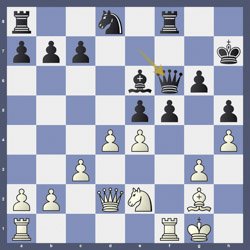
There were now pawn captures at both moves 19 and 20 but Cheshire and Schallopp disagree about the order in which these occurred. The same position them arises and the computer thinks both sequences are equally good for White.
Cheshire (pages 327-328, with notes by Tinsley) has "19 QPxP QxKP 20 PxP BxP” (i.e., 19 dxe5 Qxe5 20 exf5 Bxf5) but Schallopp (pages 314-315) reverses the move pairs, giving 19 e4xf5 (i.e., KPxP) 19… Bxf5 20 dxe5 Qxe5 and both Crouch (pages 294-295) and ChessBase follow this. None of these books has any comment at moves 19-20 and we do not know where Schallopp obtained his version of the game; perhaps it was in private correspondence from Tarrasch.
Conclusion: With no evidence to the contrary, Cheshire’s move order should be accepted, as it is by Britbase. ChessBase should change their version.
This was the last game to finish, following an overnight adjournment, and it lasted nine hours. The notes in the Cheshire tournament book (pages 334-336) were by Steinitz. Schlechter himself published the game in his Allgemeine Sportzeitung column on the 13th of October, page 1055.
The score of the game in Chessbase Mega Database 2025 (and in Crain’s book Schlechter’s Chess Games, page 31) goes: 1.e4 e5 2.Nf3 Nc6 3.Bb5 a6 4.Ba4 Nf6 5.0–0 d6 6.d4 Nd7 7.Nc3 Be7 8.Ne2 0–0 9.c3 Bf6 10.Ng3 Ne7 11.Bb3 Ng6 12.Be3 Re8 13.Qd2 Ndf8 14.dxe5 dxe5 15.Qxd8 Bxd8 16.Ng5 Bxg5 17.Bxg5 Be6 18.Ne2 Bxb3 19.axb3 Ne6 20.Be3 Rad8 21.Rfd1 f6 22.f3 Kf7 23.Kf2 Ke7 24.g3 Ngf8 25.Ke1 Nd7 26.Nc1 g5 27.Nd3 h5 28.Ke2 Rh8 29.b4 Rdg8 30.Rg1 g4 31.f4 Nd8 32.f5 Nf7 33.Nf2 Nd6 34.Bc5 Nb6 35.Nd1 Nbc8 36.Ne3 Kf7 37.Nd5 c6 38.Nc7 Nxe4 39.Rad1 Nxc5 40.bxc5 Rd8 41.Ne6 Rxd1 42.Rxd1 Ke7 43.h4 gxh3 44.Rh1 Kf7 45.Rxh3 Ne7 46.g4 h4 47.c4 Ng6 48.fxg6+ Kxe6 49.g7 Rg8 50.Rxh4 Rxg7 51.Ke3 Kf7 52.b4 Kg6 53.Rh3 f5 54.gxf5+ Kxf5 55.Rh5+ Ke6 56.Rh6+ Kd7 57.b5 axb5 58.cxb5 cxb5 59.Ke4 Re7 60.Rb6 Kc7 61.Rxb5 Kc6 62.Ra5 Re8 63.Ra7 Re6 64.Ra5 Re7 65.Ra1 Kxc5 66.Rc1+ Kd6 67.Rd1+ Kc6 68.Rc1+ Kd7 69.Rd1+ Kc8 70.Rd5 Kc7 71.Rc5+ Kd6 72.Rb5 Kc6 73.Rb1 b5 74.Rc1+ Kb6 75.Rb1 Re8 76.Rb2 Kc5 77.Rc2+ Kb4 78.Rb2+ Kc4 0–1.
The Deutsches Wochenschach (6th October, pages 352-354) had notes said to be partially by Chigorin. The game can also be found in the revised and enlarged second edition of Jimmy Adams’s book on Chigorin, pages 552-555, drawing on notes from various sources.
There are issues at moves 53 and 67 which seem easy to resolve, but then a question over the final moves of the game which is perhaps less obvious.
Our first diagram shows the position after Black’s 52nd move.
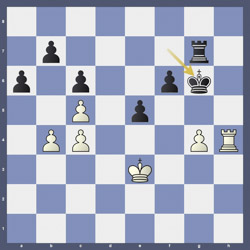
Cheshire (pages 334-336, with lengthy notes by Steinitz) had "53 R to R8" and the Wochenschach agrees, giving 53 Th4-h8(i.e., Rh8). Both Schlechter and Adams also have the rook moving to the 8th rank. On the other hand, Schallopp (pages 312-314) has 53 Rh4-h3 and both Crouch (pp291-4) and ChessBase follow Schallopp, although frankly that move makes little sense and looks like a misprint. At move 55 the Rook checked on h5 and the positions coincide again.
The next diagram shows the position after White’s 67th move where the second discrepancy occurs.
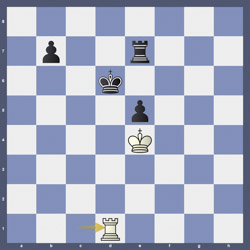
For Black’s 67th move Cheshire has “K to B2” (i.e., 67…Kc7) whereas Schallopp has Kc6. In this case, he was following the Wochenschach; both Schlechter and Adams say the same. In both versions, following 68 Rc1+, the King goes to d7 in reply, reaching the same position.
The Adams book on Chigorin agreed with Schlechter's version in the Sportzeitung about White's 53rd and Black's 67th moves, but both Adams and Crain give the long finish shown above, that is as in the Cheshire and Schallopp books, going to move 78.
On the other hand, The Field (14 September), the Wochenshach, and Schlechter's column gave a shorter version of the finish, perhaps simplified for the sake of amateur readers, though they do not say that is what they are doing. In that version, the game ended 69 Rc5 Kd6 70 Rc2 b5 71 Rb2 Kc5 and White resigned.
Conclusion: The first two cases appear to be a straightforward 1-1 draw, with the balance of primary sources favouring Cheshire with 53 Rh8 but Schallopp with 67…Kc6. The differences may simply be due to misprints overlooked by proof-readers (if there were any).
The case of the final sequence is not so clear. I tend to believe the Cheshire version must be what happened; the short version looks like a deliberate oversimplification by Hoffer for the sake of weak players which the Wochenschach copied, while Schlechter was possibly not looking at his own copy of the game (if he still retained one) when writing his article. As for Crain, we found many instances in his Schlechter book where he was not following primary sources and made mistakes.
This series will conclude soon with a concluding article summing up our discoveries. Later this month, after checking our findings and any feedback, we shall release for download (free of charge) what we believe to be the most accurate database of the tournament. We hope that future editions of ChessBase and other databases will take note.
After allowing time for feedback from readers, we also intend to submit a major article about Hastings 1895 to some chess magazines.
 Back to the index (introduction) page for the series.